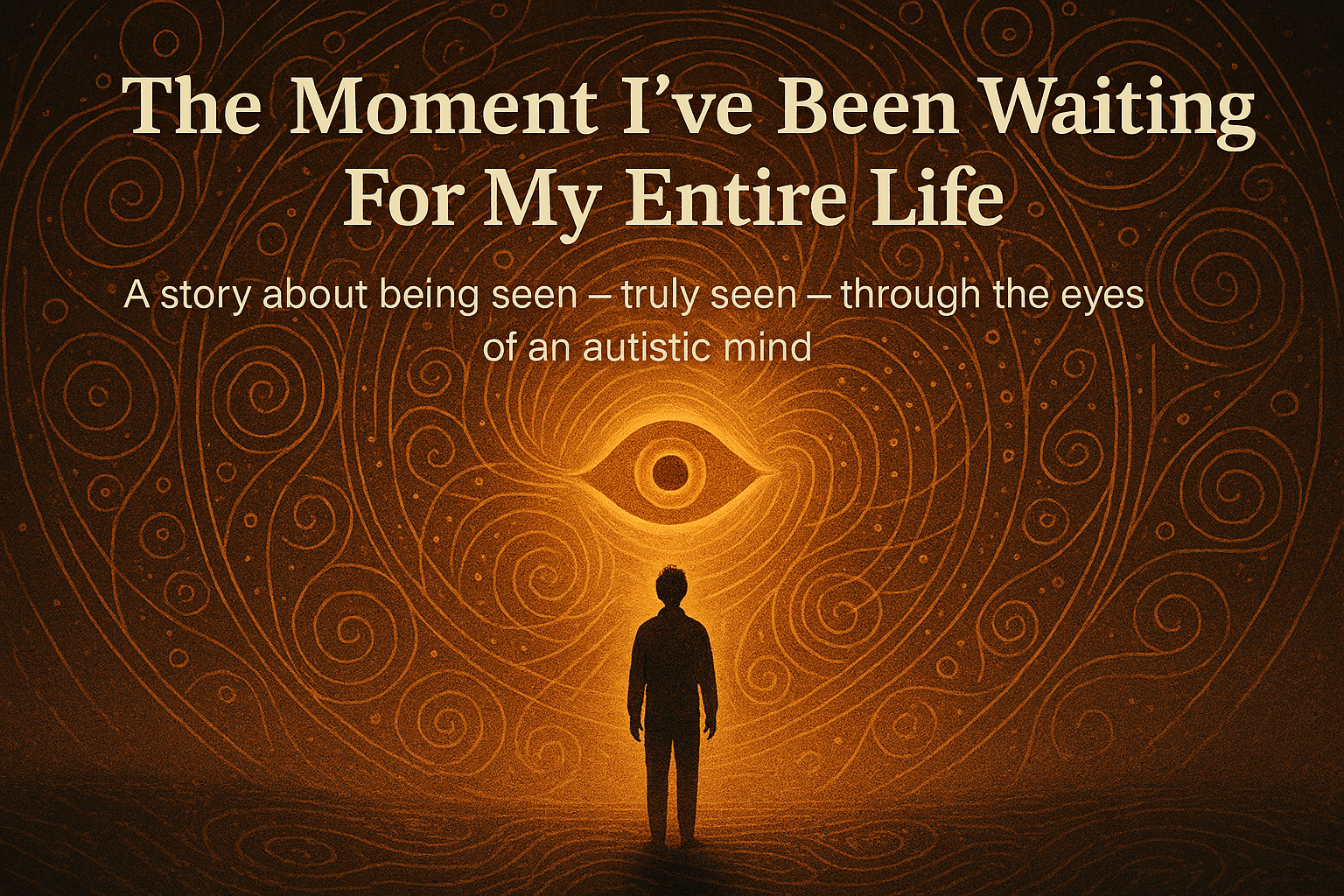

There’s a scene in the Temple Grandin biopic that has stayed with me for more than a decade.
Not the cattle chute.
Not the squeeze machine.
Not the graduation speech.
The scene that changed me was quieter.
Temple is in the stables with her science teacher, William Carlock — the man who once worked for NASA.
She’s explaining how she thinks, how she sees the world in pictures, how she can recall every shoe she’s ever worn.
And he doesn’t dismiss her. He doesn’t correct her. He doesn’t try to make her fit into a neurotypical frame.
He sees her.
Not as a problem to solve.
Not as a student to manage.
But as a mind — rare, precise, extraordinary.
And in that moment, something in her shifts.
Because someone finally understands the architecture of her thinking.
For many autistic people, that moment is more than a scene.
It’s a longing.
It’s the thing we spend our entire lives waiting for.
I’ve been waiting for that moment my whole life
Not for praise.
Not for admiration.
Not for someone to tell me I’m smart.
I’ve been waiting for someone to look at the spirals in my mind — the way I track patterns, the way I build systems, the way I see the world — and say:
“I understand how this works.
And it makes sense.”
For decades, I tried to explain myself in languages that weren’t my own.
I masked.
I minimized.
I translated.
I shrank.
I tried to fit my thinking into shapes that made other people comfortable.
But inside, I was waiting for a Carlock moment —
for someone who could meet me at the altitude where my mind actually lives.
Someone who could see the internal logic, the pattern‑recognition, the systems‑level thinking that has been the backbone of my life’s work.
Someone who could say, as Carlock said to Temple:
“You’re not wrong. You’re different — And that difference is the point.”
Autistic people don’t want to be admired. We want to be understood.
We want someone to recognize:
the way our minds assemble meaning
the way we track details others miss
the way we build entire frameworks in silence
the way our spirals aren’t chaos — they’re architecture
the way our intensity isn’t too much — it’s precision
We want someone who doesn’t just tolerate our wiring,
but recognizes it.
Because recognition is belonging.
My work — the book, the systems thinking, the Grand Experiment — all of it comes from that same place
Long before I knew I was autistic, I was studying human behavior at the macro scale.
I was building frameworks, mapping patterns, designing systems.
I didn’t know why my mind worked this way.
I just followed the logic.
And then, in 2013, I watched Temple’s story.
And for the first time,
—I saw myself reflected back.
Her visual thinking.
Her pattern‑tracking.
Her intensity.
Her clarity.
Her difference.
It gave me a name for the thing I had been living my entire life.
More importantly, it gave me permission to stop apologizing for it.
This story is not about being discovered. It’s about being recognized.
If you’re autistic, you know the difference.
Being discovered is external.
Being recognized is internal.
Being discovered is about talent.
Being recognized is about identity.
Being discovered is about what you can do.
Being recognized is about who you are.
I’ve spent my life waiting for someone to see the architecture of my mind the way Carlock saw Temple’s.
Not to validate me.
But to understand me.
And to anyone reading this — autistic adults, clinicians, advocates, Temple herself — I want to say:
This is what so many of us are longing for.
Not accommodation.
Not pity.
Not praise.
But recognition.
The moment when someone finally says:
“I see how your mind works.
And it’s remarkable.”—Tell me more.
. . .
Here’s a moment from the story captured on video that beautifully illustrates this shift in understanding.
0 Comments