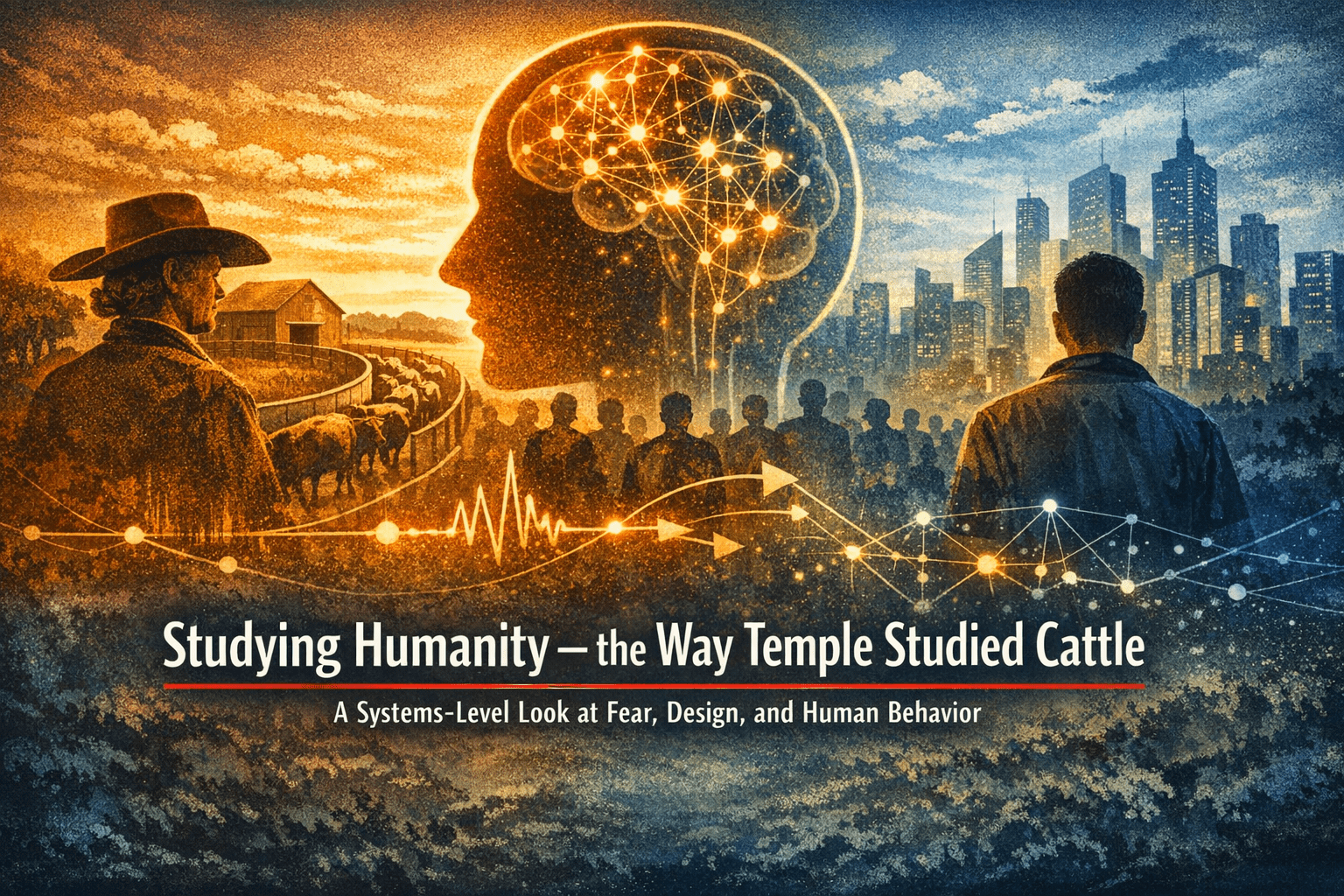

Studying Humanity — the Way Temple Studied Cattle
There’s a moment in Temple Grandin — the HBO film about her life — where Temple says something that has stayed with me for years:
“I don’t want my thoughts to die with me.”
That line hits differently when you’ve spent your life studying the world in ways most people don’t see.
Temple didn’t just observe cattle; she understood them.
She saw patterns in their behavior that others overlooked. She recognized that fear, pressure, environment, and predictability shaped their actions long before anyone else took it seriously.
And here’s the truth I’ve only recently been able to say out loud:
My life’s work has been a parallel study — not of cattle, but of humanity.
Not individuals.
Not personalities.
Not isolated stories.
But humanity as a system.
A herd.
A network.
A collective nervous system responding to pressure, environment, and design.
It took me decades to realize that what I was doing had a name.
It took even longer to understand that Temple had done it first — just with a different species.
Temple Studied Cattle to Understand Systems
People often misunderstand Temple’s work as “animal behavior research.”
But what she actually did was map the physics of a nervous system under pressure:
how fear spreads
how environment shapes behavior
how predictability calms
how design influences movement
how one individual’s reaction affects the whole group
She wasn’t studying cows.
She was studying systems.
Cause and effect.
Stimulus and response.
Environment and outcome.
And she was doing it with a clarity that came from her autistic way of seeing the world — noticing patterns others missed, connecting dots others didn’t know were dots.
I’ve Been Doing the Same Thing — Just With Humans
For as long as I can remember, I’ve been watching humanity the way Temple watched cattle.
Not judging.
Not moralizing.
Just observing.
How people move through the world.
How they respond to pressure.
How fear spreads through a community.
How predictability calms a group.
How design shapes behavior.
How systems create outcomes long before individuals make choices.
I’ve been studying humanity at scale — the way a systems engineer studies flow, the way a behavioral scientist studies patterns, the way Temple studied movement in a chute.
And like Temple, I didn’t start with theory.
I started with observation.
I watched how families function.
How communities form.
How helpers burn out.
How advocates rise and fall.
How society organizes itself around fear, scarcity, and confusion.
How people behave when they feel safe — and when they don’t.
I didn’t know it was research.
I didn’t know it was a framework.
I didn’t know it was a body of work.
But it was.
The Grand Experiment Is My Version of Temple’s Early Work
Temple redesigned cattle chutes to reduce fear and panic.
I’ve been redesigning human systems to reduce fear and disconnection.
Temple created environments where animals could move calmly and predictably.
I’m creating environments — through writing, structure, clarity, and community — where humans can move calmly and predictably.
Temple showed the world that behavior is logical when you understand the system.
I’m showing that human behavior is logical when you understand the social system.
Temple’s work changed an industry.
My work aims to change how we understand ourselves.
Not through force.
Not through persuasion.
But through design.
Why This Matters to the Autism Community
Autistic people often see the world in patterns.
We notice the structure beneath the noise.
We see the system behind the behavior.
Temple used that gift to improve the lives of animals and the people who worked with them.
I’m using that same gift to improve the lives of humans — especially autistic humans — by helping the helpers, building clarity, and creating systems that reduce overwhelm, confusion, and emotional chaos.
Because here’s the part Temple understood — and the part I’m finally ready to say out loud:
When you study a system long enough, you eventually realize you’re not just observing it.
You’re responsible for improving it.
Temple didn’t wait for permission to redesign the chute.
She saw what was broken, understood why it was happening, and built something better.
That’s the work I’m doing now.
Not to fix people.
Not to diagnose society.
Not to judge the herd.
But to redesign the conditions we’re all moving through — so fear doesn’t have to be the default, confusion doesn’t have to be the norm, and overwhelm doesn’t have to be the cost of being human.
Temple’s legacy wasn’t about cattle.
It was about clarity.
Mine isn’t about individuals.
It’s about systems.
And like Temple, I don’t want my thoughts to die with me.
I want them to become blueprints — for helpers, for communities, for autistic people who see the world in patterns, and for anyone who’s ever felt the system pushing them in directions that never made sense.
This is my life’s work.
This is my version of Temple’s early research.
This is the beginning of the redesign.
And we’re just getting started.
0 Comments